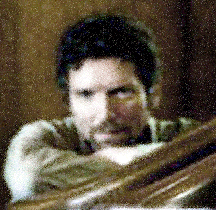
Despite the brilliance of Anne Mitrani, Lisa Lichtenfels, and Ron Mueck, (see part three), and as "alive" as their creations are, one is still left the fact that they are not moving. One of the more delightful ways to animate a puppet is with strings. The wonder of this for me was brought home in the movie Being John Malkovich with John Cusack. The opening scene shows puppets being maneuvered so delicately, so humanly, and so sensitively that it is a jaw-dropping scene. It's worth the rental just to watch those few moments. From then on I didn’t have much exposure to that form of puppetry, so even more reason for my delight in reading a Financial Times (of all places!) article, this weekend, entitled Pulling the Strings by Sarah Hemming. It is not available online to link to you, so below I have excerpted what to me are some of the highlights.
The article states that, “Little Angel, Britain’s oldest surviving marionette theatre has had a new lease of life.” Apparently it was on the verge of bankruptcy. Loss of funding led to a six-month closure but it reopened after getting funded on the centenary of its founder, John Wright. The current artistic director Peter Glanville says, “It’s taken a while for people to realize how much skill lies in the art of puppetry and how many different types there are. It’s a six-month process to develop a puppet.”
The article goes on to explain that, “The Little Angel Theatre itself is a diminutive treasure. Today the auditorium is flanked by a workshop, where specialists carve the pint-sized casts. The stage can accommodate many types of puppetry, including ‘black-light’ (the puppeteers are obscured by lighting) and short–string marionettes (with the puppeteers on stage). But its unique asset is a ‘double bridge’ (narrow balconies above the stage), enabling puppeteers to operate long-string marionettes. Peering down over the rails—a 2 metre drop—I realize how much skill it must take to control tiny gestures. ‘Marionette work is relatively rare,’ says general manager Charlotte Bond: ‘It is so specialized and you need a bridge, so there aren’t many places to perform it in this country.’”
“The theatre is using its grant from the UK’s National Lottery to celebrate marionette work, creating a touring show, running courses and hiring two apprentices to hone the skill of making stringed puppets. It hopes to take puppetry forward and bring it to new audiences.”
“We want to create work that explores the boundaries of what puppet theatre can be,” says Glanville. He is particularly proud of a new initiative offering artists from all disciplines a chance to experiment with puppetry, ‘I get calls from chamber orchestras, from opera companies, from dance companies, all wanting to work with puppets.’”
So why this surge in interest from mainstream companies? Glanville attributes it partly to the fact that British theatre has evolved over the past 20 years to include more visual, physical drama. Also, festivals of international work have showcased puppetry traditions from elsewhere, such as Balinese shadow and Vietnamese water puppets.
It was a Japanese bunraku show that inspired Royal Shakespeare Company’s Gregory Doran to stage Venus and Adonis. In this ancient form each puppet has several skilled operators controlling precise movements. ‘This is an art form in which puppetry, narration and music are held in absolutely equal balance,’ he says. ‘I was also very impressed by the fact that the entire, very large audience was adult.’”
“Doran thinks that part of the attraction for adults is that audiences are hungry for work that emphasises its theatricality: ‘There is now more of a celebration of how theatre is different from film and television. In puppetry, you are asked to believe that a block of wood is the goddess Venus. If you do that, if you involve yourself in that imaginative leap, that act of complicity, then it becomes super-real.’”
“Having made the leap, audiences can be led into fantastical worlds. That puppets are being manipulated also intrigues adults. Doran says, ‘We like a world in miniature that we can control.’”
Showing posts with label 3D. Show all posts
Showing posts with label 3D. Show all posts
Tuesday, February 13, 2007

Saturday, February 10, 2007
Three-dimensionality part three (footnote)
What art offers is space - a certain breathing room for the spirit.
John Updike
Big thanks to Mike Brent who after my February 6 post commented:
On a similar note, here's a super-cool video about Ron Mueck, ultra-realist sculptor extraordinaire:
25min documentary
small clip
His stuff is so real it's scary!
If you haven’t checked out these clips, please do. Shelley and I watched them last night (Shelley for the second time) and we were awed by how real and evocative Ron Mueck’s works are. Then I awoke this morning and realized that something was missing. It was the joy. There was no joy. Now, I do understand that art does not have to be joyful. In fact, part of its value is often to stir us up. Nevertheless, art for me is primarily pleasure and joy is the quality I look for as an inner response to what I am viewing.
With Anne Mitrani and Lisa Lichtenfels there is a compelling joyousness that draws me in. With Ron Mueck I am left outside the work as a neutral observer-perhaps not so neutral, because I feel a certain emptiness. Of course, my rambling thoughts do not take away from the brilliance of the work and the clips are really a must see.
John Updike
Big thanks to Mike Brent who after my February 6 post commented:
On a similar note, here's a super-cool video about Ron Mueck, ultra-realist sculptor extraordinaire:
25min documentary
small clip
His stuff is so real it's scary!
If you haven’t checked out these clips, please do. Shelley and I watched them last night (Shelley for the second time) and we were awed by how real and evocative Ron Mueck’s works are. Then I awoke this morning and realized that something was missing. It was the joy. There was no joy. Now, I do understand that art does not have to be joyful. In fact, part of its value is often to stir us up. Nevertheless, art for me is primarily pleasure and joy is the quality I look for as an inner response to what I am viewing.
With Anne Mitrani and Lisa Lichtenfels there is a compelling joyousness that draws me in. With Ron Mueck I am left outside the work as a neutral observer-perhaps not so neutral, because I feel a certain emptiness. Of course, my rambling thoughts do not take away from the brilliance of the work and the clips are really a must see.
Tuesday, February 6, 2007
Three-dimensionality – part three of five
Our duty, as men and women, is to proceed as if limits to our ability did not exist. We are collaborators in creation.
Teilhard de Chardin
The first home that Shelley and I moved into was a ramshackle cottage that we rented in the canyons above Beverly Hills. We found it in the two weeks in the year when the place was livable. After that it was either freezing cold—Shelley sitting in front of her computer with several layers of clothes on top of which she wrapped herself in a blanket under which was a radiator. Or too hot—Shelley could only work in the evenings. Nevertheless, we thought it was heaven and the best place we had ever lived (which amazingly we have said with each subsequent place).
During that time of our life Shelley and I would go on what we called “life-enriching adventures” which we would surprise each other with. Having lived in either London or Los Angeles, in equal measure my whole life, these were not exotic treks into the wilderness, these were urban adventures. One such adventure was a visit to a Museum of Miniatures. (The museum has since closed, but I can assure you that Hila’s work would be a star exhibit if it was still open).
Halfway through the museum, I stopped in front of an exhibit and could not believe what I was seeing. The dolls I was viewing, behind glass, looked like real children. I waited, expecting them to move. I was looking at the work of Anne Mitrani. I was now hooked on puppetry. From pop-ups, to automata, and now to this. Awareness of three-dimensionality was born inside of me and has continued to fascinate me with its seemingly mystical dimension--further awakening me to my own dimensionality.

Later that year Shelley introduced me to the soft sculpture of Lisa Lichtenfels. Yes, these "alive" humans are just fabric and stitching. Again, I was awed.

Well as you can see this has now expanded to a five-part post. More to come.
Teilhard de Chardin
The first home that Shelley and I moved into was a ramshackle cottage that we rented in the canyons above Beverly Hills. We found it in the two weeks in the year when the place was livable. After that it was either freezing cold—Shelley sitting in front of her computer with several layers of clothes on top of which she wrapped herself in a blanket under which was a radiator. Or too hot—Shelley could only work in the evenings. Nevertheless, we thought it was heaven and the best place we had ever lived (which amazingly we have said with each subsequent place).
During that time of our life Shelley and I would go on what we called “life-enriching adventures” which we would surprise each other with. Having lived in either London or Los Angeles, in equal measure my whole life, these were not exotic treks into the wilderness, these were urban adventures. One such adventure was a visit to a Museum of Miniatures. (The museum has since closed, but I can assure you that Hila’s work would be a star exhibit if it was still open).
Halfway through the museum, I stopped in front of an exhibit and could not believe what I was seeing. The dolls I was viewing, behind glass, looked like real children. I waited, expecting them to move. I was looking at the work of Anne Mitrani. I was now hooked on puppetry. From pop-ups, to automata, and now to this. Awareness of three-dimensionality was born inside of me and has continued to fascinate me with its seemingly mystical dimension--further awakening me to my own dimensionality.

Later that year Shelley introduced me to the soft sculpture of Lisa Lichtenfels. Yes, these "alive" humans are just fabric and stitching. Again, I was awed.

Well as you can see this has now expanded to a five-part post. More to come.
Sunday, February 4, 2007
Three-dimensionality – part two of three
The most beautiful thing we can experience is the mysterious. It is the source of all true art and all science. He to whom this emotion is a stranger, who can no longer pause to wonder and stand rapt in awe, is as good as dead: his eyes are closed.
Albert Einstein


After Shelley saw my interest and delight with pop-ups, she introduced me to automata. Again my fascination was with the fact that you could simply take paper, scissors, and glue and make these moving objects. This was another step for me. Now illustrations were not only leaping off the page, but moving as well.
My first attempt and still my favorite automata is the Cat Walk shown above. Shelley and I found it serendipitously when we were looking for an actual cat walk for our cats. It opened up a world for us. It is very interesting to see the eyes, of people who come into my office, widen in awe as they start playing with Cat Walk’s mechanism. They think I am an engineering genius for putting what is in actuality a very simple paper kit together.
If automata appeals to you check out Paper Animations to see other working models of other delights designed by Rob Ives. There are many other automata makers out there but Rob Ives’ have a special lightness of touch and humor that is second to none. If Shelley were designing automata it would be like Rob’s.
Albert Einstein


After Shelley saw my interest and delight with pop-ups, she introduced me to automata. Again my fascination was with the fact that you could simply take paper, scissors, and glue and make these moving objects. This was another step for me. Now illustrations were not only leaping off the page, but moving as well.
My first attempt and still my favorite automata is the Cat Walk shown above. Shelley and I found it serendipitously when we were looking for an actual cat walk for our cats. It opened up a world for us. It is very interesting to see the eyes, of people who come into my office, widen in awe as they start playing with Cat Walk’s mechanism. They think I am an engineering genius for putting what is in actuality a very simple paper kit together.
If automata appeals to you check out Paper Animations to see other working models of other delights designed by Rob Ives. There are many other automata makers out there but Rob Ives’ have a special lightness of touch and humor that is second to none. If Shelley were designing automata it would be like Rob’s.
Tuesday, January 30, 2007
Three-dimensionality -- part one of three
The extent of your consciousness is limited only by your ability to love, and to embrace with your love, the space around you, and all it contains.
Napoleon Bonaparte
My love affair with three dimensions really started when one day I was browsing in Crown Books, in Santa Monica, and Shelley pointed out to me Robert Sabuda’s brilliant pop-up book, The Wizard of Oz. I opened it up and my jaw dropped. I bought it immediately for $16.95 before the bookshop discovered it had made a mistake. I was certain that the book really cost over $100, as such were the amazing details.
I resolved to be become an expert on paper engineering. I still have that resolve. What a delight it is to create a three-dimensional moving work of art from just a few pieces of folded paper. I have made various attempts at origami, but that for me is more of a mental process. Pop-ups are a total giddy delight.
Since then, Shelley and I have purchased all manner of pop-up books. The latest we acquired was by Robert Sabuda’s partner, Matthew Reinhart. His pop-up book, The Jungle Book has brought lots of giggles to our home and is our most prized book. Matthew really seems to have advanced the art. I hope you can see from the pictures below how the tiger leaps off the page. What you can’t see is how the claws menacingly unfurl as the page is slowly opened.


Napoleon Bonaparte
My love affair with three dimensions really started when one day I was browsing in Crown Books, in Santa Monica, and Shelley pointed out to me Robert Sabuda’s brilliant pop-up book, The Wizard of Oz. I opened it up and my jaw dropped. I bought it immediately for $16.95 before the bookshop discovered it had made a mistake. I was certain that the book really cost over $100, as such were the amazing details.
I resolved to be become an expert on paper engineering. I still have that resolve. What a delight it is to create a three-dimensional moving work of art from just a few pieces of folded paper. I have made various attempts at origami, but that for me is more of a mental process. Pop-ups are a total giddy delight.
Since then, Shelley and I have purchased all manner of pop-up books. The latest we acquired was by Robert Sabuda’s partner, Matthew Reinhart. His pop-up book, The Jungle Book has brought lots of giggles to our home and is our most prized book. Matthew really seems to have advanced the art. I hope you can see from the pictures below how the tiger leaps off the page. What you can’t see is how the claws menacingly unfurl as the page is slowly opened.


Subscribe to:
Posts (Atom)